Erosion control in Portland, Oregon
Cover that holds on slopes, in the rain, and under inspection. Seeding, bonded mulch, blankets and silt fence, matched to the season and the permit your site is under.
Multnomah, Washington and Clackamas counties.
Portland, wet season. Miss it and you are looking at a correction notice or a stop work order.
Erosion control and sediment control are two jobs
Permits usually ask for both, and people mix them up.
Erosion control stops soil moving in the first place. Cover goes over the dirt so rain cannot pick it up. Seeding, mulch, blankets and matting all do this.
Sediment control catches soil that has already started moving. Silt fence, inlet protection, sediment traps and check dams all do this.
Cover is the cheaper of the two, because keeping soil in place costs less than chasing it. That is why seeding is on almost every plan in this region.
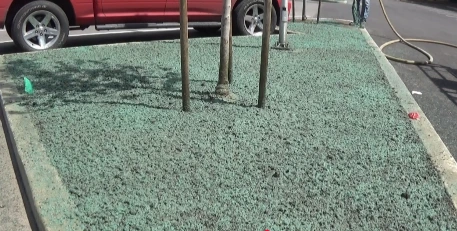
What we install
Which combination you need depends on slope, soil, the time of year and what your plan calls for.
Hydroseeding
Seed, mulch, fertilizer and tackifier sprayed as a wet mix. Fast over large open areas and it grows into permanent cover.
Bonded fiber matrix
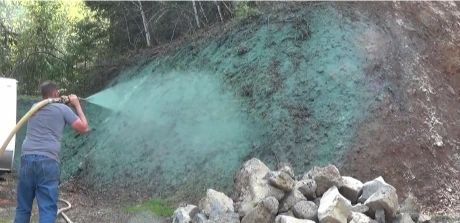
A heavier sprayed product that locks to the surface and holds where standard mulch would slide.
Erosion control blankets
Rolled matting, pinned down. Works where a sprayed product will not hold, and through winter when seed will not germinate.
Straw and compost cover
Accepted locally as ground cover when seeding has not come in. The backup when you run past the seeding window.
Silt fence
Perimeter sediment control, trenched in along the downhill edge.
Slope and bank stabilization
Steep ground specced by grade and rainfall exposure rather than by square footage alone.
How the two seasons change the job
This is the part that catches people out, and it is driven only by the date.
- Weekly documented inspection, recorded on site
- Extra inspection within 24 hours of rain over half an inch
- Ground disturbing work banned entirely in the Balch Creek and Forest Park subdistricts
- Same duty to keep soil on site, longer window to act
- The sensible season to plan seeding around
- Schedules tighten through September
The state permit works differently. The 1200-C has no wet or dry season rule. It runs on calendar days and site size: under five acres you get 14 days to complete stabilization once started, five acres and over you get seven. Inside Portland on a site over an acre, both apply at once. Work to whichever is tighter.
Sources: City of Portland, rainy season requirements. Oregon DEQ, 1200-C permit, Schedule A.16. Full detail on our Portland rules page.
When does the site count as stabilized?
For a 1200-C site, DEQ approves termination once you have uniform perennial vegetation, not counting noxious or invasive weeds, giving at least 70 percent cover.
You then file a Notice of Termination within 30 days of meeting the criteria. It needs photographs of the final stabilization, unless DEQ inspected the site in the previous 30 days, plus the status of any open compliance issues and payment of outstanding fees. You stay bound by the permit until DEQ approves it.
So the sequence is cover, grow, document, file. Not cover and walk away.
Source: Oregon DEQ, 1200-C permit, Schedule A.17 and Condition I.10
Common questions
How quickly can you get on site?
Call and ask. Scheduling tightens up through September as everyone tries to beat October 1.
Can you work in the rain?
Often yes. Steady rain is usually fine. The problem is heavy rain in the first day or two after a sprayed product goes down, before it sets, which is why slope jobs get planned around the forecast.
Will seeding alone pass an inspection?
Only once it grows in. Seed on the ground is a start, not a finish. On a 1200-C site the standard is 70 percent cover.
What if I seed and it does not come up before October?
Then you need another form of cover. Straw, yard debris compost or an erosion control blanket are the usual options.
Do you install silt fence as well?
Yes. Most plans pair perimeter sediment control with surface cover.
What size sites do you take?
Everything from a single lot to multi acre work. Call with your square footage or acreage.
Where we work
Washington County sites fall under Clean Water Services standards rather than Portland’s, so the detail differs. Say where the site is when you call.
Multnomah County
Washington County
Clackamas County
Describe the site and we will price it
One phone call is usually enough. If you are working toward a close out date, tell us and we will say honestly whether seed will get there.
[TRACKING NUMBER]- Acreage or square footage
- How steep the ground is
- Which permit the site is under
- Your deadline